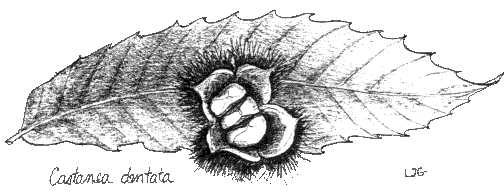
American Chestnut (Castanea dentata): In the first 40 years of the 20th century, chestnut blight destroyed 3.5 billion American Chestnuts. What had been the most important tree in our Eastern Forests was reduced to insignificance. No comparable devastation of a species exists in recorded history.
ACCF is a nonprofit scientific and educational foundation, organized in 1984, dedicated to restoring the American Chestnut to its former place in our Eastern hardwood forests. Priorities include the development of blight resistant all-American Chestnuts and economical biological control measures against chestnut blight in the forest environment. We support American Chestnut research and engage senior citizens and school children, volunteers and professionals in planting, grafting and managing the fruits of this research.
The Lost Treasure
When the Europeans arrived in North America, one-fourth of the trees in the forest were American Chestnuts (Castanea dentata). Commonly over one hundred feet tall with trunks five to seven feet in diameter, they were the tallest and most bountiful member of the forest community. The durable, straight-grained wood was used for houses, barns, furniture, paneling and fences. Today much of the rail fencing along the Blue Ridge Parkway is chestnut. A dependable yearly crop of nuts provided food for wild birds, squirrels, turkeys, deer, and bears and cash for mountain families. Before 1900 and the introduction of Chestnut blight, Chestnut mast fell like rain in the fall of the year. After the blight struck, it left in its wake over 3.5 billion dead Chestnut trees and a void that could only partially be filled by Oaks and other tree species. Through the years, much has been learned about Chestnut Blight and breeding for resistance so that today, with recent breakthroughs, restoration of the American Chestnut tree is increasingly possible.
The ACCF is Restoring American Chestnuts by:
Breeding for blight resistance. ACCF all- American intercrosses accumulate resistance exclusively from American Chestnuts. We do not use hybrids, other Castanea species or GMOs in our breeding program.
Cloning resistant American Chestnuts. The ACCF grafts scions of American Chestnuts with tested blight resistance onto existing sprouts in selected forest settings.
Reclaiming the habitat needed to rescue the species. Where clearcutting, fire and storms create suitable openings, we reestablish American Chestnuts by cutting the competing hardwoods, planting and grafting blight-resistant chestnuts and introducing hypovirulent (weakened) strains of the blight fungus. This is integrated management for blight control.
You Can Help
Join the ACCF. Your support will help fund research to:
 |
Discover chemical markers for blight resistance, |
|
Improve breeding efficiency, |
|
Refine the biological controls of blight, and |
|
Apply integrated management on forest sites. |
Adopt a forest revival plot. Ideal American Chestnut habitat is found on sloping lands at low to medium elevations, in coves or slopes facing east to north, with many chestnut stems, sandy loam soil and full sunshine. Good site indicator trees are tulip poplar, cucumber magnolia and red oak. When openings occur on these sites, they should be managed for American Chestnut recovery; no other use could match the potential benefit to the forest environment.
Plant American Chestnuts and report their progress to ACCF. Visit our website for details.
Please visit our websites at
American Chestnut Cooperators' Foundation
Newport, Virginia
ACCF is a 501(c)(3) non-profit organization. Dues and all contributions are tax deductible.
Please send donations to:
American Chestnut Cooperators' Foundation c/o Martin Arthur CPA
PO Box 6174
Christiansburg, VA 24068
Send ACCF e-mail to Ed at Ed@accf-online.org
Gary
Griffin, President Emeritus, Professor of Plant Pathology, Virginia Tech
Ed Greenwell, President & Director of
Breeding, Electrical Engineer, New Johnsonville, TN
Jennifer Abla , Vice President, Arborist,, Black
Mountain, NC
Phillip N. Martin, Treasurer, CPA,
Christiansburg, VA
Joyce G. Foster, Secretary,
Research Biochemist, Beaver, WV
Denise Greenwell,
Webmaster, Computer Engineer, New Johnsonville, TN
Lucille Griffin,
Executive Director Emeritus, Newport, VA
ACCF is a 501(c)(3) non-profit organization. Dues and all contributions are tax deductible.
Page by Ed Greenwell Last updated 11/06/2022